Tag Archives: How to Write

Key Sentence Skeletons

Is there a recipe for the 10 key sentences?

RECIPE

Recipe for Key Sentences in a Grant Application?

This post is about an easy way to work out what to write the 10 key sentences that define a grant application. There are two reasons I think it’s worth writing even though I have written about the key sentences several times recently.

  • A good set of key sentences is half-way to a case for support. A really good case for support consists of nothing more than the 10 key sentences and the text that fills in the detail and convinces the reader that the key sentences are true. Of course this extra text is much more than filler, but it is a great help to have the key sentences because they define the task of the rest of the the text.
  • I have been working with a couple of clients who, even though they are clever people and they get the idea of key sentences, find it really hard to write them. So I have been on the lookout for a good way of making it easy to write a good set of key sentences.

Skeleton sentences, which Pat Thomson’s excellent blog recommends as a way of handling difficult but often repeated writing tasks such as framing a thesis introduction, or introducing a theoretical framework, look perfect. You take a key sentence that works; you separate it into its component parts and identify the parts that are specific to its current use and the parts that are generic. Then you turn the generic parts into a skeleton and replace the parts that are specific to its current use with equivalent parts that are specific for your use, and you have your own equivalent sentence.

Complication warning

ComplicationWarningI should perhaps warn you at this stage that although this post really does simplify the process of writing key sentences, it is quite detailed and it doesn’t do anything else. So if you aren’t trying to write a grant application   you should probably just bookmark the page and return when you start writing your next grant.

Finally, before I get down to the nitty gritty, I have two strong recommendations.

  1. It is very risky to start writing key sentences before you have worked out the details of your research project. As soon as you have done that you should divide it into three or four sub-projects, each of which will find something out, establish something, or develop something. This post tells you how to do that.
  2. Although it makes most sense to read about  the key sentences in numerical order, it’s pretty hard to write them in that order. I’ll make some suggestions about writing order as I explain the recipes.

So, what would skeletons for the 10 key sentences in a grant application look like? I think I can tell you in 9 of the 10 cases. I will describe them in numerical order, which is the order in which the reader will encounter them.

Key sentence 1, the Summary sentence

The first sentence of the proposal, key sentence 1, is probably the most complex and variable of the key sentences. It gives a simple overall statement of what the project will achieve, ideally it will relate that achievement to a big important problem and will also include something distinctive about how the project will achieve it in a way that will make it clear that you are a suitable person to do the project.

A minor variation of a sentence I suggested in an earlier post about key sentences, does all this. It has four parts, which are numbered.

  1. This project will develop a new potential treatment for stroke
  2. by identifying, synthesising and testing suitable molecules
  3. from a family of novel synthetic metabolic inhibitors
  4. that we have discovered.

A skeleton representation of the four parts would be:

  1. This project will [your own description of  how it will make partial progress towards solving a  huge, important problem – in the example it’s “develop a potential solution”]
  2. by [ your own much more specific description of what it will actually do]
  3. [your own assertion that the project is novel or timely – e.g.”novel synthetic metabolic inhibitors”]
  4. [your own claim to “ownership” of the project – e.g.”that we have discovered”].

I would suggest that you leave the first key sentence until near the end. I would also suggest that you content yourself with a rough draft initially. You will have plenty of time to refine it as you flesh out the detail int he case for support.

Key sentence 2, the Importance sentence

The second key sentence states the importance of the specific outcomes promised by the project. The following sentence does this in two ways. The first clause gives some evidence that the big problem is really important. The second clause asserts that the specific problem that will be solved by the project is an important aspect of the big problem.

  1. Stroke is one of the commonest causes of death and disability in the working population;
  2. one of the most promising new avenues of treatment is to shut down brain function reversibly using a metabolic inhibitor, we have yet to identify a suitable molecule.”

Its skeleton is

  1. The [huge important problem] is [your own statement that demonstrates with evidence that the problem is very important for one or more of health, society, the economy and the advance of knowledge and understanding];
  2. [your own statement that the project outcome will contribute to solving the huge important problem].

I think that the second key sentence is definitely the last one to write.

Key Sentences 3-5, the Aims sentences

Sentences 3-5 would be the first and the easiest sentences for you to draft. They are what I used to call the “we need to know” sentences. There is one for each sub-project. An example from our hypothetical stroke project would be:- We need to identify which molecules in this family are most effective as reversible inactivators of brain tissue. The skeleton for an aims sentence would be something like this.

We need to [know or establish or develop]+[your own statement of whatever the sub-project is going to discover or establish or develop].

Each of the aims sentences introduces a section of the background to the project (the bit where you justify the need for your research) in which you convince the reader, by citing relevant evidence, that the key sentence is absolutely, starkly and compellingly true. You would also re-use the same sentence in the introduction to the case for support and in the summary.

Specific Aims

Some funders – notably NIH and the UK research councils, like you to talk about aims, or even specific aims. For this you create a compound of all 3  aims sentences of the following form.

We have three (specific) aims:-
1) to [discover, develop or establish] [your statement of whatever the first sub-project is going to discover, develop or establish]
2) to  [discover, develop or establish] [your statement of whatever the second sub-project is going to discover, develop or establish]
3) to  [discover, develop or establish] [your statement of whatever the third sub-project is going to discover, develop or establish]

Key Sentence 6, the Project Overview sentence

This sentence introduces the description of the research project by saying what kind of research it will involve, something about the facilities it will use – especially if these are distinctive in some way, and what it will discover. It may say something about the resources it will use. It is very similar to sentence 1 but it might have a bit more information about the kind of research and the specific outcome.

The following sentence, in italics, is an example related to our example of sentence 1. The proposed project will be a mixture of synthetic chemistry to produce candidate molecules and in vitro physiology to test their efficacy in producing reversible inactivation of brain slices in order to identify a potential treatment for stroke. The skeleton sentence, is The proposed project will [general description of research activity] to [specific description of research outcome] in order to [weak statement indicating partial progress towards solution of huge important problem].

I think that the project overview sentence should be written after the sub-project overview sentences.

Key Sentences 7-9: Sub-project Overview sentences

Each sub-project has a “this will tell us” sentence that matches the “we need to know” sentence but is a little bit more complex. It begins with a clause that summarises what you will do in the sub-project and continues with a main clause that says what it will tell us. For example:- We will use voltage sensitive dyes to assess the activity and responsiveness of brain slices in order to measure the effectiveness of different molecules as reversible inactivators of neural activity.

The skeleton would be:- We will [do the relevant research activity] in order to discover [the thing that we said we needed to know in the corresponding Aims sentence].

If your funder asks you to list research objectives as part of the grant application, or if it suits your writing style you can phrase (or rephrase) your “this will tell us” sentences as statements of objectives. They would read like this.

The research objectives are as follows:-
1) to [do the relevant research activity] in order to discover [the thing that we said we needed to know in the corresponding Aims sentence].
2) to [do the relevant research activity] in order to discover [the thing that we said we needed to know in the corresponding Aims sentence].
3) to [do the relevant research activity] in order to discover [the thing that we said we needed to know in the corresponding Aims sentence].

Key sentences 7-9 can be written as soon as you like. You should have everything you need to write them right at the start. However, they are a bit more tricky than key sentences 3-5, which is why I recommend that you start with those.

Key sentence 10, the Dissemination sentence.

The dissemination sentence should introduce a description of the projects dissemination phase. It may say something about what you will do with the results to create a platform for future research – by you or by others. The range of possible dissemination strategies is too great for me to construct a skeleton, however I will comment on the relative importance of dissemination versus building a platform for future research. The relative importance depends somewhat on key sentence 2.

Dissemination beyond the research community is important if key sentence 2 claims that the importance of your project is related to some practical problem or opportunity (curing a disease, making a technological breakthrough). Your dissemination plan will need to include steps you will take to make sure that the results are put to use and your project. You may also be requesting funds for dissemination activities.

On the other hand, if the importance of your project is purely to do with its potential to advance your subject, you probably do not need to say much about dissemination activities although it might be important to talk about communicating the results to your research community by publication and conference activity.


Speed-Writing Grant Applications in Vienna

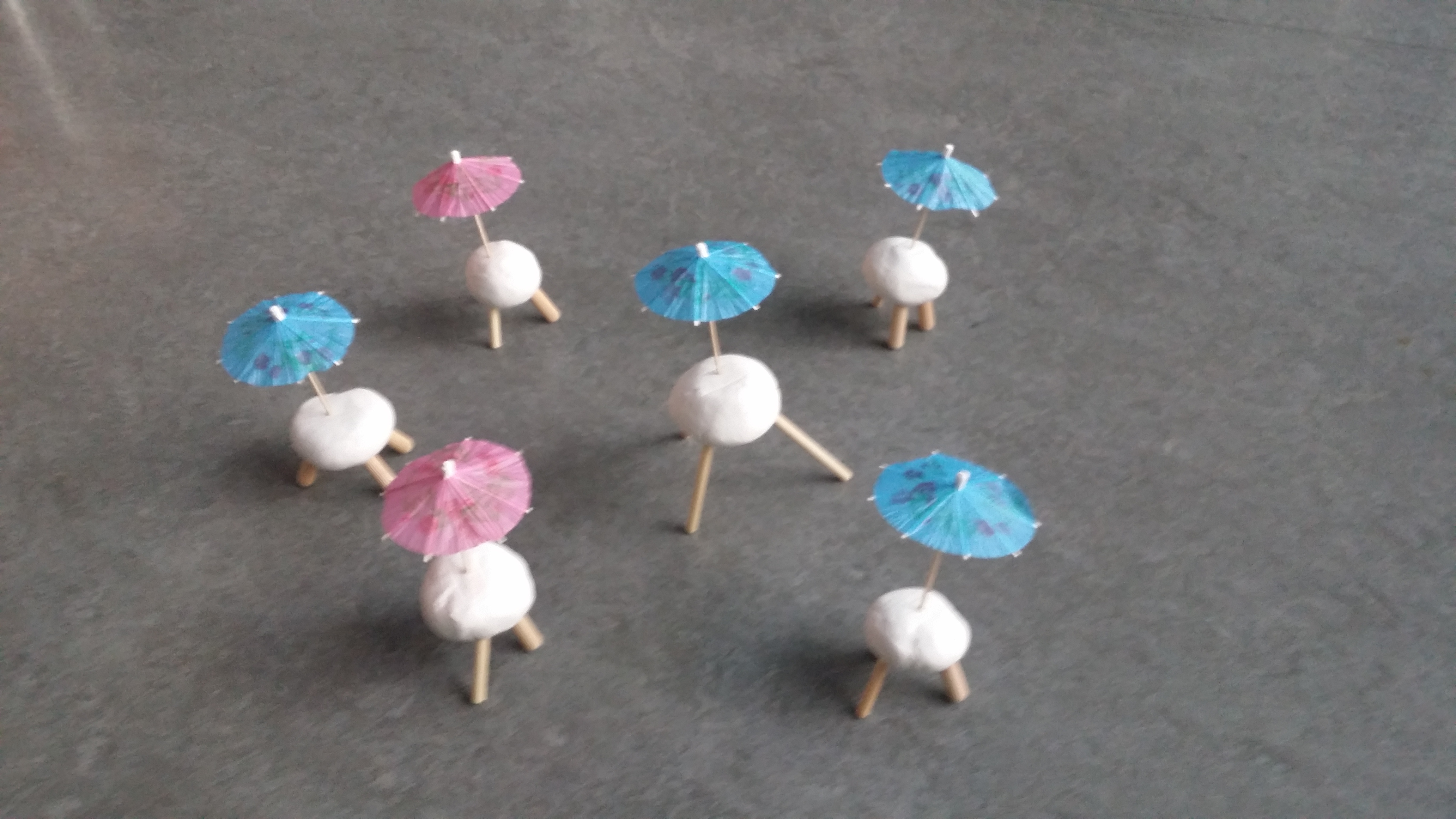
Models produced in a project design and collaboration game we played at the Vienna workshop.

Models produced in a project design and collaboration game played in the Vienna workshop.

I have always found it frustrating that it takes so long to discover whether people learn anything in my workshops. It can take weeks, months or even years for somebody to come back with a draft grant application, although I do recall one awkward occasion when I was delighted to receive a complete draft application within an hour of the workshop. Unfortunately the delight did not last long: it soon became clear that the only thing the writer had learned was my email address!

Part of the reason for slowness is that writing is a slow business. It’s slower still when writing something to be be criticised and slowest of all when the task of designing a project has to come before the writing starts. In the past I tried to compensate by encouraging everyone to write, allowing them to write almost anything, and using the writing process to bootstrap the design of the project.  This approach can take an awful lot of feedback, delivered over many iterations, to develop a polished grant application.

Recently I have taken a harder line. Regulars will have seen that I don’t think you should start writing until you have a project to write about. When you start writing, you should draft your skeleton of key sentences very quickly. Then get straight on with adding the flesh that will convince the skeptical reader that the key sentences are true.

It’s easy to take a hard-line approach on a blog, where readers will stop reading, rather than giving feedback about problems. Last week I decided to take the hard-line “write right now” approach face-to-face. I started a worksop by getting participants to write the first sentence of an application twice, once for their own project and once for someone else’s. Then, after a couple of presentations to teach them about style and content, I set them to divide their project into 3 or 4 sub-projects and to write the 10 or 12 key sentences.

In order to get participants over the project design stage, I used a brilliant idea given to me by Amanda West, from the University of Sunderland. Amanda pointed out that, for training purposes, it is easier to write a grant application for a project that has already been done. I had instructed applicants to prepare for the workshop by conceiving a research project based on their own PhD thesis, or on a published paper, if they didn’t have a project they wanted to do already in mind.

One of Vienna's famous trams outside the Vienna Biosciences Centre

One of Vienna’s famous trams outside the Vienna Biosciences Centre

I am convinced that this approach, building the skeleton of a case for support by drafting key sentences, is the fastest way to get a grant application written, as well as being the best way not to waste time on a never-ending grant application. The results of the workshop were pretty encouraging. Most of the participants produced a full set of key sentences and several got to the point that they were fleshing them out with evidence and explanation before the end.

Of course there are many uncontrolled variables. For example, the participants – all post-docs from the University of Vienna Biosciences Centre – were exceptionally good, even though for most of them English was their second or third language. However, it also seemed clear that if it hadn’t been for the tasks I presented them with, most of them wouldn’t have got over the inhibition that everyone faces with a blank page. So I’m delighted to have found a way to get people writing key sentences even before they have a project because I am more than ever convinced that writing key sentences is the fastest way to write a well-structured grant application.

The Summary: Your direct line to committee feelgood.

18534682_sNot many people realise that the summary section on your grant application is a direct line to the most influential member of the committee that decides where it sits in the funding priorities. You can make this person feel really good about your application, just as they start to read it. Let me explain how it works.

Grants committees everywhere are overloaded, thinly stretched and work very fast. Committees I have worked on would decide on a £300K grant in less than 10 minutes. Sometimes a lot less. I can remember a panel that decided on 72 applications in 6 hours. Meetings commonly last two days, so committee members will often have more than 100 applications to read for a meeting.

The subject spread of the applications is an even bigger problem than the numbers. Everybody on the committee is an expert on something. But expertise tends to have a very narrow focus, and for any individual member, most of the applications are outside that focus. Committees cope with this by designating a member, sometimes two or three, to become an expert on each grant. It is the job of these designated members to present the grant application to the committee.

The designated member is crucial to the success of your application. They explain to the committee what the grant is about. They say what the applicants propose to do, what are the specific research aims, how the proposed research project will meet those aims, and what will be done with the results. They summarise the referees’ recommendations and they recommend a score. It takes about 5 minutes. This presentation is hugely influential. Most of the committee will go along with the recommendation.

This system, or something like it, is widely used in the UK and overseas. There’s an excellent video illustrating how the US National Institutes of Health does it on youtube.

The nature of the review process means that the summary of your grant application has a huge influence on the designated member who presents your grant. Let me put you inside the head of a one-time presenter.

Presenting a grant is not easy. It’s always a stretch to get your head around someone else’s research ideas. There is a lot to keep straight in your head. And you are presenting in front of colleagues whose respect is important to you. You don’t want to look as if you are out of your depth in front of them. You feel that you want to do a good job.

Actually, you have to do more than one good job. Usually you have to prepare several presentations and keep them all straight in your head. Then you present them as each grant comes up. I once had to do 12 in one day.

As you pick up each application on which you have to prepare to speak, you have in mind both a nightmare and a dream. You can probably guess what the nightmare is. I want to tell you about the dream, because you have the chance to make it come true.

The dream is that the summary, which is the first thing you read, will start by saying exactly what problem the applicant proposes to solve and how. Then it will say what it is that makes the problem important, what are the specific research aims, how the proposed research project will meet those aims, and what will be done with the results. In short, the designated member’s dream is that the summary would be the ideal set of notes for a talk to explain the grant to the committee.

The dream continues: the introduction to the case for support makes exactly the same statements as the summary. Then the remainder of the case for support convinces the reader that the statements are true with detailed, evidence-based, argument and explanation.

So think about this dream as you write the summary of your next grant proposal. Make the dream come true. It will give your grant a huge advantage in committee.

Aims and Objectives, why the world needs your research.

the-mountainAims and objectives provide an excellent framework for the case for support in a research grant application.

A well-written case for support states an overarching aim based on a big research question. It shows how this big question gives rise to three or four smaller questions and then describes a research project that will answer those questions. The compelling logic for the reader is that the project deserves to be funded because it has been intricately designed to answer the big question. The truth may be that the intricacy lies more in the writing than in the project’s design. Matching sets of aims and objectives can be crafted to link a pre-designed project to a pre-existing big question.

Before we consider how to do this, let’s be absolutely clear about the difference between aims and objectives. There’s an excellent discussion of the difference in the context of a PhD project,  by Pat Thomson. She defines the aim as “…what you want to know…” and the objectives as “…the specific steps you will take to achieve your aim..”  This definition works perfectly for our purposes.

We can apply this distinction more or less directly in a grant application as follows.

  • Aims are the knowledge and understanding that you need in order to answer your research question. Well-designed aims create clear links between your research project and the big, important question that motivates it.
  •  Objectives are specific research actions that you plan to carry out in your research project. The objectives define the structure of the research project.  This means that if you design your project carefully, it will be clear that your research objectives will fulfil the aims defined by your research question.

The easy way to link up the aims and objectives is to start by describing the research that you want to do and what it will find out. You should divide your research project into (or assemble it from)  three or four sub-projects. Each sub-project will lead to a clear discovery or outcome. Each  outcome generates an exactly corresponding aim. If you want to do a sub-project that will discover how neurones in the cerebral cortex respond to lights of different colours, you have to have the aim “We need to know how neurones in  the cerebral cortex respond to lights of different colours”. Working backwards from the objectives in this way means that aims and objectives match perfectly. No skill is required

The place where skill is required is in tying together the three or four aims and making the case that meeting each of them will make a significant contribution to solving a larger research problem that is important to your target funder. That is where the real skill of writing grant applications lies.

For completeness, in addition to this set of three or four aims with precisely matching objectives, I would recommend another four sentences which are a more complex mix of aim and objective and which would be used to set the context in any full statement of the aims and objectives. So a full statement of the aims and objectives would be as follows.

  • The first sentence, which would be the first sentence of the case for support, would be a one sentence summary of the whole proposal. It would state the overall aim of the project, which is to take us closer to solving the larger research problem, and the overall objective, which is to carry out the research project. This is a very difficult sentence to write but a very important one, for two reasons. First, it gets the reader excited about the project by telling them its aim and its objective. Second, because it tells everything in a single sentence, it can afford to gloss over uncertainties, helping the reader to form a positive view of the project.
  • Second, there is a sentence that states why the research problem is important and which may also introduce the specific aims.
  • Immediately after this sentence you would state the three or four specific aims.
  • Third, after stating the specific aims, you need to set the scene for stating the specific objectives with an introductory sentence that describes the nature of the research project.
  • The three or four specific objectives, stating research outcomes that exactly match the specific aims, would be stated immediately after it.
  • After the objectives, there should be a sentence that says what will be done with the research outcomes. In a sense this is an overall objective which should ensure that the overall outcome of the research project  contributes to solving the larger research problem that motivates the entire project.

Finally I should make it clear that, although it matters for understanding this post, for the purpose of grant-writing,  it doesn’t matter that some authorities, including the Oxford dictionary, do not distinguish between aims and objectives in exactly the same way as I do. What matters in a grant application is how you present the argument that links your project to the important question. Whether you call any individual link an aim or an objective is neither here nor there.


Get the Framework in Place – Quickly

Framework

In this post I want to describe the framework of a grant application. Its components are the key sentences in the case for support that define its essential message. I will explain what the sentences are and how you use them to build the framework. Then I want to explain how you can draft the sentences very very quickly.

The essential message of a grant application’s case for support is carried in ten key sentences, which make the case in headlines. The rest of the document fleshes out that case, provides evidence and makes it believable. But the key sentences set out what has to be believed. They say what the research project will achieve, why it is important, how it will achieve its goal and what you will do with the results. That is the sense in which they carry the essential message.

So what are the 10 key sentences?

Sentence 1 is very important. Its function is to make the reader want to read on by giving them a sense of what your research project will achieve. A good way to do this is to state the overall outcome of the project and to specify enough detail about the project to make it seem both feasible and distinctive. For example, the sentence “This project will develop a new potential treatment for stroke based on a family of synthetic metabolic inhibitors that our group has discovered, tested and synthesised” does all this. Like many introductory sentences, it is quite long. The length is due to extra information that makes it clear both what the approach is and that the project is building on previous work by the applicants. The project would have seemed less feasible and less distinctive if the sentence had stopped at the word “stroke“.

Sentence 2 should give evidence that the problem to be solved is important. A good sentence 2 (assuming it’s true) would be “There are 152000 strokes per year  and over 600,000 disabled stroke survivors in the UK: a suitable metabolic inhibitor could reduce the disability caused by stroke.” It is a common mistake to say something like this in the first sentence but it does not engage the reader so effectively as a promise that the project will bring us closer to solving the problem.

Sentences 3-5 state that we need the outcomes of the research project. In order to make it easy to explain your project it is best to break it into 3 sub-projects, each of which will have a clear outcome. Before you describe the project, sentences 3-5 sell the project to the reader by stating  that each of the outcomes is important. Each of the sentences can be a simple statement that “We need to know” whatever the sub-project will discover.

Sentence 6 introduces the research project. It is an introductory sentence and it can help to add some complexity to make the project seem more feasible and more distinctive. For example, the hypothetical stroke project would be helped by some reference to the achievements of the research team or to the distinctive facilities available.

Sentences 7-9 describe each of the sub-projects. Each sentence says what the sub-project consists of and what its outcome will be. It is crucial that the outcomes match exactly the outcomes sentences 3-5 said were important.

Sentence 10 says something about what will be done with the outcomes to maximise the benefit that will accrue from the project.

Where do the key sentences appear?

Each of the key sentences should be used three times. First they appear consecutively in the introduction of the case for support. The introduction may also include some linking statements but no other substantive messages.

The sentences appear again in the main body of the case for support. This time each sentence introduces a significant section of text that fleshes out and justifies its message.

Third, the summary of the project should be virtually an exact copy of the introduction to the case for support.

How do you write the key sentences quickly?

As I will explain below, it should be possible to produce first drafts of the key sentences in less than an hour. I recommend that you use the draft key sentences as a framework for writing the two main sections of the case for support, the background and the description of the research project.

The first sentences to write are sentences 7-9. Each one states what research you will do in one of your sub-projects and what the outcome of that research will be. Usually the outcome will be that you will know something or understand something that currently is not known or understood. For example, if you were carrying out a project on the importance of writing in the practice of social work, sentence 7 might be:-

We will analyse and quantify texts and explore how writing is being managed alongside other commitments in order to discover the institutional writing demands of contemporary social work.

If you have worked out what your project will consist of and why it is worth doing then it should be really easy to write sentences 7-9. And if you haven’t, you shouldn’t be writing, you should be designing your project.

As soon as you have written sentences 7-9 you need to write sentences 3-5. Each of these sentences has to state the reason that the outcome of one of your sub-projects is important. It should use exactly the same wording to describe that outcome as its corresponding sentence 7-9. So the sentence 3 corresponding to the sentence 7 above could say something like:-

We need to know the institutional writing demands of contemporary social work so that we can identify the writing skills that social workers need.

Notice that the description of what the sub-project will discover appears in exactly the same words in both sentences.

Sentence 6 should also be fairly easy. It is a descriptive sentence that summarises the main features of the research project. These features are itemised in the first clauses of each of the sentences 7-9. You simply need an overarching summary. It should only take you a couple of minutes.

If you haven’t thought hard about dissemination it will be impossible to draft the definitive version of sentence 10 at this stage. However, you should force yourself to write something quickly now. What you write may be rather unconvincing at this stage, but the effort of writing it will be a stimulus for you to think about that phase of the project as you flesh out the case for support. Don’t spend more than 5 minutes on it at this stage.

Now it is time for sentence 1. This is the hardest sentence to write and it’s nearly impossible if you try to write it too soon. It should be pretty easy now because you have written sentences 3-10. The ideal form of sentence 1 is that it states a big question to which all of your sub-projects contribute. It then adds some detail about how you will do the project. This detail should be drawn from sentence 6. With the preparation you have done, sentence 1 should take no more than 10 minutes.

Don’t worry that your sub-projects don’t answer the big question completely. They never do. The knack is to find a big question that fits loosely, but not too loosely, around your project. It has to be clear that your project will contribute to answering the big question you have chosen. It is accepted that there is a trade-off between how completely you answer the question and how big it is – everybody knows that it took more than one research project grant to find the Higgs particle.  You cope with the fact that your project will not answer your big question completely by choosing your words carefully. Notice that, in my sentence 1, I have been careful to use the term “potential treatment”. It would be implausible to claim that the project would develop an actual treatment.

Once you have a draft of sentence 1, sentence 2 should be very quick and easy to draft. All you need to do is to give a reason that your contribution to answering the big question is important.  This reason should be a fact about the world (the If drafting sentence 2 takes you more than a minute then you need to redraft sentence 1. Even with a redraft, you should have your framework well within the hour. If it takes you more than two hours, then you are not ready to write the grant. Find out how to get ready by reading this post.