

Tag Archives: Framework

Aims and Objectives, why the world needs your research.

the-mountainAims and objectives provide an excellent framework for the case for support in a research grant application.

A well-written case for support states an overarching aim based on a big research question. It shows how this big question gives rise to three or four smaller questions and then describes a research project that will answer those questions. The compelling logic for the reader is that the project deserves to be funded because it has been intricately designed to answer the big question. The truth may be that the intricacy lies more in the writing than in the project’s design. Matching sets of aims and objectives can be crafted to link a pre-designed project to a pre-existing big question.

Before we consider how to do this, let’s be absolutely clear about the difference between aims and objectives. There’s an excellent discussion of the difference in the context of a PhD project,  by Pat Thomson. She defines the aim as “…what you want to know…” and the objectives as “…the specific steps you will take to achieve your aim..”  This definition works perfectly for our purposes.

We can apply this distinction more or less directly in a grant application as follows.

  • Aims are the knowledge and understanding that you need in order to answer your research question. Well-designed aims create clear links between your research project and the big, important question that motivates it.
  •  Objectives are specific research actions that you plan to carry out in your research project. The objectives define the structure of the research project.  This means that if you design your project carefully, it will be clear that your research objectives will fulfil the aims defined by your research question.

The easy way to link up the aims and objectives is to start by describing the research that you want to do and what it will find out. You should divide your research project into (or assemble it from)  three or four sub-projects. Each sub-project will lead to a clear discovery or outcome. Each  outcome generates an exactly corresponding aim. If you want to do a sub-project that will discover how neurones in the cerebral cortex respond to lights of different colours, you have to have the aim “We need to know how neurones in  the cerebral cortex respond to lights of different colours”. Working backwards from the objectives in this way means that aims and objectives match perfectly. No skill is required

The place where skill is required is in tying together the three or four aims and making the case that meeting each of them will make a significant contribution to solving a larger research problem that is important to your target funder. That is where the real skill of writing grant applications lies.

For completeness, in addition to this set of three or four aims with precisely matching objectives, I would recommend another four sentences which are a more complex mix of aim and objective and which would be used to set the context in any full statement of the aims and objectives. So a full statement of the aims and objectives would be as follows.

  • The first sentence, which would be the first sentence of the case for support, would be a one sentence summary of the whole proposal. It would state the overall aim of the project, which is to take us closer to solving the larger research problem, and the overall objective, which is to carry out the research project. This is a very difficult sentence to write but a very important one, for two reasons. First, it gets the reader excited about the project by telling them its aim and its objective. Second, because it tells everything in a single sentence, it can afford to gloss over uncertainties, helping the reader to form a positive view of the project.
  • Second, there is a sentence that states why the research problem is important and which may also introduce the specific aims.
  • Immediately after this sentence you would state the three or four specific aims.
  • Third, after stating the specific aims, you need to set the scene for stating the specific objectives with an introductory sentence that describes the nature of the research project.
  • The three or four specific objectives, stating research outcomes that exactly match the specific aims, would be stated immediately after it.
  • After the objectives, there should be a sentence that says what will be done with the research outcomes. In a sense this is an overall objective which should ensure that the overall outcome of the research project  contributes to solving the larger research problem that motivates the entire project.

Finally I should make it clear that, although it matters for understanding this post, for the purpose of grant-writing,  it doesn’t matter that some authorities, including the Oxford dictionary, do not distinguish between aims and objectives in exactly the same way as I do. What matters in a grant application is how you present the argument that links your project to the important question. Whether you call any individual link an aim or an objective is neither here nor there.


Review a Research Grant Application in Five Minutes

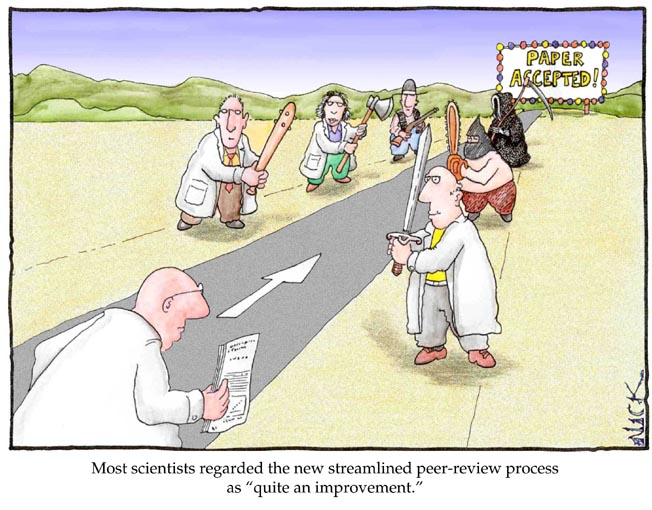
PeerReviewCartoon

Cartoon by Nick D Kim, http://strange-matter.net

This post tells you how to do a five-minute review of a research grant application. If you are asked to comment on a grant application by a friend or colleague, you should begin with this five minute review. In 95% of cases it will be all you need to do. Except create the feedback sandwich of course.

If you are writing a grant application, before you ask anybody else to read it you should spend five minutes reviewing it yourself. Far too many of the grant applications that I get asked to read take me a lot less than five minutes to review. Then it takes several days to construct a palatable feedback sandwich with the filling  “rewrite this completely”.

I don’t say you can review the detailed content of a grant application in five minutes. That takes longer and I will write about how to do it quickly in a future post. However, five minutes is plenty of time to review the framework of the case for support and check that it is appropriately used.

The framework is important for two reasons. First, if it is good, it tells the reader the essential story of your grant application very quickly. Remember, most readers only want to know the essential story. Second, the framework guides the reader to the detailed content that supports and justifies the essential story, so that the detail can be reviewed effectively and quickly.

‘Summary Sentence’

The most important part of the framework is a summary sentence. This should say what the project will achieve and enough about how it will achieve it to give a bit of distinctiveness and a bit of plausibility. It is essentially the elevator pitch, except that instead of taking 30 seconds to 2 minutes to say it or read it, it should take more like 15 seconds. The summary sentence should be the first sentence of the introduction, so it should take no time to find it, you still have 4 minutes 45 seconds left.

If you read my last post you will recognise that the summary sentence is what I refer to there as the first key sentence. So it will come as no surprise that you should check that the summary sentence is re-used as the first sentence of the part of the case for support that sets out the background to the research project. Let’s allow 15 seconds to do that. 4 minutes 30 seconds left.

‘Importance Sentence’

Now you should spend 20 seconds checking the second sentence of the introduction. It’s the importance sentence. It should say something about why it is important to achieve whatever the project will achieve. Make a mental note about whether the importance sentence has a practical element. Does it mention a real world problem – childhood cancer, the economy, forgetfulness in old-age, or some such. It’s not essential that there is a practical element to the importance sentence but it has implications for the dissemination sentence, which you will review in a few minutes time.

As soon as you have checked the importance sentence for practical content, jump to the background section and check that the importance sentence is repeated there. This is just a quick glance, so it should only take you 10 seconds. You have 4 minutes left.

‘Aims Sentences’

Go back to the introduction. Immediately after the importance sentence there should be a set of aims sentences, about four sentences setting out the aims of the project. The aims sentences should state things that we need to know, understand, characterise or in some way discover. The aims sentences could be preceded by a linking or framing sentence and they could easily be formatted as bullet points. Checking that the aims sentences are in the right place should take you 10 seconds. Do not look at the content of the aims sentences yet. Wait 30 seconds until we get to the sub-project overview sentences.

Now you should check the next sentence of the introduction. It should be the ‘project overview sentence’.

Project overview Sentence.

The project overview sentence gives a simple one-sentence overview of the project. It might also be structured as a linking sentence to the four or so sub-project overview sentences, which should immediately follow it and which could appear as bullet points and could be expressed as objectives. It should take you 30 seconds to read the project overview sentence and 20 more to check that it appears again to introduce the part of the case for support that gives the detailed description of the research methods and of the project.

Next you can spend 10 seconds checking that the sub-project overview sentences follow the project overview sentence. Now you are ready to check their content against the content of the corresponding aims sentences.

Sub-project overview sentences; content of aims sentences

Each aims sentence should link logically to the corresponding sub-project overview sentence in the following way. The aims sentence should say “We need to know X”. The sub-project overview sentence should give a very brief description of the research in the sub-project and should end with a clause that says “this will tell us X“.

The aims sentences should be repeated in the background. Each of them should introduce a discussion of the evidence that supports the assertion that this is an important aim.

The sub-project overview sentences should be repeated in the part of the case for support that describes the project in detail. Each of them should introduce the detailed description of the corresponding sub-project.

This checking and matching will probably take nearly a minute to do for the first aim/sub-project overview sentence pair but the others should be much quicker. It’s just a matching exercise after all. Lets assume it takes 2 minutes. You have a minute left, and only the dissemination sentence to check.

The dissemination sentence

The last sentence of the introduction should say what will be done with the results. It is the dissemination sentence. You need to check that it is repeated in the description of the project as the introduction to a section on dissemination. You also need to check that, if the importance sentence has a practical component then the dissemination must have a corresponding practical element. For example, if the project is going to discover a cure for a disease, the dissemination needs to promote the use of the cure in some way. As a general rule there must be a plan to disseminate the results in a way that makes it likely that the claimed practical benefit will be realised.

What to do with the outcome of the review

Only about 5% of grant applications will pass this five minute review. If you are reviewing a grant application for someone else and it passes, it should be pretty easy to review the detailed content. I’ll give some helpful pointers in a future post. It goes without saying that if the grant you are reviewing is yours, it is safe to give it to someone to review.

In the more likely case that the grant application fails the review, then it needs rewriting. If it’s yours, that’s pretty simple. Read my post from last week. Write the 10 key sentences and use them to organise the text you have already written. If you can’t write the 10 key sentences then you shouldn’t be writing a research grant.

If the grant application is not yours, you need to write a feedback sandwich. Basically the grant needs to be rewritten before it’s worth looking at the detailed content. I’ll say something about how to do this in my next post but whatever you do don’t use the phrase “completely rewrite”.